



From: Alban Tufa Illustration source: Pixabay, worked from Jorono The Europe we have loved so much “We want Albania like all of Europe”, this was the call of student protesters in the early 1990s, which, helped by many other factors, led to the fall of the communist system and the establishment of political pluralism after
From: Alban Tufa
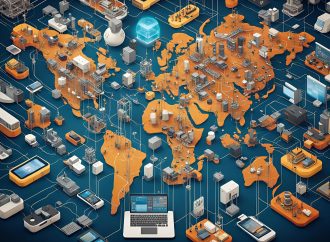
Illustration source: Pixabay, worked from Jorono
The Europe we have loved so much
“We want Albania like all of Europe”, this was the call of student protesters in the early 1990s, which, helped by many other factors, led to the fall of the communist system and the establishment of political pluralism after 45 years of dictatorship in Albania. With the same call, the student protests of 2018 took place near the Ministry of Education, which imposed several improvements to the education system in Albania. This makes us understand that for Albanians, the European Union has been and continues to be a dream.
The geographical position, historical past, economic and cultural context, have created space for many actors, internal and external, to extend their agendas to Albanian public opinion, thus interfering with the process of Albania’s Integration into the European Union.
Klajdi Kaziu has just completed his second master’s degree with a focus on European Integration issues. Since the age of 18, which coincides with the age of political awareness, he has been liberal in his views. He loved expansion, especially the expansion of culture, its stratification. He spoke with these ideas easily with his friends, in various debates and discussions. He easily defended the idea that Albania is integrating, that it should be integrated and that the process is progressing at a normal pace. But over the years, this became more difficult for him. While the process during the years 2019-2024 was blocked, it was not at all easy for him to find arguments to support his beliefs. The process had already become difficult, as were his conversations with friends.
Klajdi Kaziu, EU and integration expert. Photo: Top Channel
However, since August of last year, many things changed. Negotiations with EU were opened. Among other things, the language of Brussels changed. Meanwhile, they started talking with concrete dates: 2027, 2030, etc. All this was surprising because all parties changed their approaches. The entire campaign of the Socialist Party was built on this discourse. Today, even from the perspective of an expert who has just started his career, Klajdi Kaziu is more hopeful than ever that his country will be part of the European Union.
The majority of the Albanian population shares his opinion. The current perception of the Albanian public towards the EU is positive. Over 90% of Albanians, according to the latest Eurobarometer in September, are in favour of Albania’s membership in the EU. Meanwhile, the EU Delegation in Tirana, according to the Barometer published by Euronews Albania, is one of the institutions that enjoy high credibility.
According to Klajdi Kaziu, the Albanian public does not have much knowledge about EU issues. “In Albania, people know Open Balkan very well because two Balkan prime ministers focused their discourse on this process, and the media also treated it as a priority. I cannot say the same about the EU, because Albanians know little or nothing about this process,” he says.
Love and skepticism
“The EU has workers from Africa and the Middle East, resources from Arab countries, protection from America. Many ethnicities (and laughing emoji)”. This is a common and contained comment in posts against the EU on TikTok. “The EU is a failed project”, writes one commenter after him. In the two comments of the same post, the conversation is extended with other comments about the state of the EU, how it does not love Albanians, or how skeptical citizens are about this political project. Other users in this post and other posts with the subject of the European Union, bring some Europe critic verses by the poet Gjergj Fishta, Islamic culture, the family breakdown in European societies and many other skeptical perspectives as arguments against the EU Integration process.
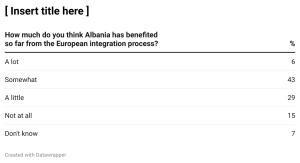
Meanwhile, in a survey conducted with 381 citizens results indicate that, in their opinions, Albania has not benefited enough from the EU. This survey is conducted independently by the author between August and September 2025 as part of the research method for this article. The survey was conducted online and included 381 respondents aged 18–65, selected through a snowball sampling method via different Social Networks aiming to represent a diverse cross-section of Albanian citizens.
Çelik Rruplli, a media analyst with a focus on EU and Integration issues, indicates that the main reasons that influence or feed scepticism towards the EU in Albania are the anti-EU narratives that are ‘blown’ by third countries and embraced by populist political movements of the extreme right and left. According to him, fragmented public communication focusing on half-truths by public officials also affects the misinformation of citizens.
As always happens, misinformation, half-truths or narratives against a subject leave their effect. Thus, some citizens become sceptical, and even try to find other alternatives with which the Government can form an alliance. Added to this situation is the slowness with which the integration process is moving. “Another element that influences the growth of scepticism is the slowness or failure to fulfil promises related to the integration process, increasing citizens’ distrust in the commitments that are made to fulfil the conditions,” says Rruplli.
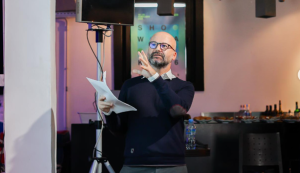
Çelik Rruplli, Media Analyst at Europe House. Photo: UN Albania
The (bad) media coverage of the integration process
These ideas against the EU and the integration process are, at least, amplified in the Albanian media landscape. The formula is well-known. Who owns the media, owns the minds. “The coverage of the integration process in the Albanian media is very superficial. I cannot say whether it is intentional or accidental, but most journalists or guests in the media debates have little or no knowledge of the integration process. Journalists who deal with these issues are either uninformed or not invested in these topics because they probably do not bring any audience or clicks to the online media,” says Klajdi Kaziu.
Experts claim the Albanian media system, in the way it operates, often influences the amplification and transmission of half-truths and uncontrolled news. According to Rruplli, “Their fragmentation, copy-paste texts, ‘clickbait’ headlines that often invoke emotion or fear, and the lack of context in articles, leave room for misinformation and defeat their purpose. Fortunately, there are also independent media and fact-checking platforms that contribute to debunking them.”, – he says.
Besar Likmeta, editor-in-chief of BIRN Albania, sees the main problem as the fact that in Albania there are no journalists specialised in these issues, especially for the EU, where according to him, nothing is reported from the field, having as the only option to receive news from abroad. “We have usually had Western media sources. What they write, for example about President Putin, is simply translated into our media, and the journalists justify themselves with the argument that they have quoted. But there is no context, the news is unbalanced. So, broadcasting anyone’s statements has become something natural in the Albanian media landscape,” says Likmeta, as he points out that with the closure of Voice of America, a gap has been created that is also being filled by eastern media.
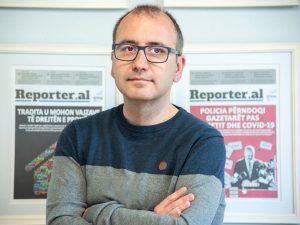
Besar Likmeta, editor-in-chief of BIRN Albania. Photo: BIRN
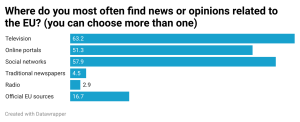
Unlike the trends of recent years where citizens are informed mainly in online media and social networks, when it comes to information about integration issues, as the table below shows, they mostly choose traditional media, especially TV.
Disinformation about the integration process
Given the lack of expertise on integration issues, economic, political and other motives, the process of Albania’s integration into the EU has been constantly accompanied by information disorder. These information disorders that interfere with the integration process have different sources and take different forms. Some of the content appears as reports of events related to the process itself, some have the nature of open-ed articles, while another part appears as posts by individuals, commentators, or various organizations on Social Networks. These types of media products contain disinformation, content with errors and sensationalist articles with unverified claims, which sometimes directly or indirectly build narratives against the Integration Process. For Klajdi Kaziu, there are many cases when the reports made by Brussels are biased.
While for Besar Likmeta, the biggest sources of disinformation and misinformation are social networks, where the content is extremely short, where users do not think long about the things they consume, or where they often only read the news headlines. “Usually, the general public does not have information about the integration process, because the process is essentially very technical. But this process depends on the things around the public. Therefore, this public can be easily misinformed because it does not know the technical aspects of integration.” – says Likmeta. According to him, different content has different risks. He states that: “News content is more dangerous than what we call Open-Ed, because Open-Eds are more understandable and the authors present their analysis.”
This concern is also raised by Klodiana Kapo, Executive Director of the fact-checking platform Faktoje.al, as when talking about the way EU and Integration issues are covered, she emphasises: “Entertainment formats such as talk shows can contribute, intentionally or unintentionally, to the spread of inaccurate claims by inviting guests who express unsupported opinions.”
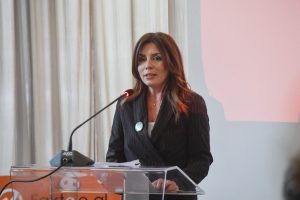
Klodiana Kapo, Executive Director of Faktoje.al. Photo: Faktoje.al
Foreign Information Manipulation and Interference
In a statement made in December 2024 before the Commission against Disinformation, the Albanian Minister of Interior at the time, Ervin Hoxha, stated: “We are clearly aware of online media in the Albanian language, but which originate in Russia and other malicious countries. There is no instrument to deal with online media that originate in Russia and which are in the Albanian language. Internal disinformation also remains a big problem, they are not formal and do not hold accountable for what they say,” he said. Meanwhile, two months earlier, the chairman of the Electronic and Postal Communications Authority, Tomi Frashëri, had stated in one of the sessions of this commission that the institution his heads has closed 155 Russian domains. Although the institutions are aware and say that they have taken action, the situation is worrying.
In May 2024, a statement by the Russian parliament speaker, Vyacheslav Volodin, took a lot of attention and space in the online media in Albania. The news published in the Albanian media was copy/pasted by the Russian media and spread quickly. In content, the news combines the statement of the speaker of the parliament, the statement of the spokesperson of the Russian Foreign Ministry, Maria Zakharova, and the Union of Journalists in Russia, criticizing the EU sanctions to ban the broadcasting of some Russian media in the Union countries. The news is without context, is not subject to any fact checking, is not balanced at all, does not show any shadow of doubt about the sources while being served as truth. The narrative that seeks to be honored through this news is as follows: Europe behaves hypocritically by promoting freedom of expression and not implementing it. This lack comes because Europe is Russophobe. But how does this news come to Albania?
As can be seen from the table below, the news was initially distributed on March 18, 2024, at 07:29 in the morning by the Russian state media Tass.ru. Exactly two hours later, the news was posted translated into Albanian and distributed through their copy/paste platforms, without changing anything in the content of the news, except for the title, which does not change in meaning but only in the quantity and positioning of the words.
After the news is posted on Albanian online media, it is then shared on Facebook pages of these media outlets or other media outlets. The statement of the Union of Journalists of Russia, presented in the news as a reliable source of information, was distributed two months ago by the Russian Embassy in Albania, on its Facebook page.
From what is understood above, some of the online media in Albania have Russian state news agencies as a source of information. However, up to this point, there seems to be no problem. The issue becomes problematic when this news item is classified as disinformation. The fact-checking platform EUvsDisinfo categorises this news item as fake. In response to this news EUvsDiSiNFO states: “The EU has repeatedly stated that the fight against disinformation is a key priority for the Union. In 2015, the East StratCom Task Force was created to better forecast, address, and respond to the Russian information year. In 2018, the European Commission presented an action plan to counter disinformation. In 2020, the European Commission adopted the European Democracy Action Plan to build more resilient democracies across the EU.
The statement closes by emphasising that: “The EU countries are considered free and democratic by Freedom House. In contrast, Russia is considered one of the least free countries in the world. This is the reason why pro-Kremlin disinformation narratives strongly attack democracy and the EU as a viable model to Russia’s autocratic system.
Based on the way the news was written, the time of publication, the choice of the headline, and the fact that this news is not true, it is understood that this narrative is not random and differs completely from sporadic disinformation. This news are amplifications of the Russian media in Albania. The conclusions of a 2022 monitoring by Disinfo.al, “show that although Albania may not always be a direct target of Russian disinformation, pro-Kremlin narratives have circulated in Albanian-speaking media at a higher rate than previously reported (before 2022), which suggests that the information environment in the country is not immune to Russian disinformation.”
Social Networks: Facebook, TikTok and YouTube as contributors to the development of disinformation
“Since the EU doesn’t want us in the EU, okay, no one is going to leave if they don’t want us. But in the meantime, Albania can rightly look at other alternatives.”. This is the first sentence of a Facebook post in 2022, which has received 194 likes, 37 comments and 5 shares. “Chinese President Xi Jinping warned that the world is facing a choice between peace and war, while holding China’s largest military parade, accompanied by Russian leader Vladimir Putin and North Korean leader Kim Jong-un, concluding a week of diplomatic displays, seen as a message to the West.”. This is also the first sentence of a video post on Facebook by one of the most followed media outlets in Albania. The post has received over 2,200 reactions, 274 comments and 52 shares. While the video lacks context and suggests to the viewer (even unintentionally) the achievements and unification of the Eastern Bloc against the Western one. The comments are divided into those praising and those criticising the Eastern Bloc. There are many sympathisers who support communist and authoritarian countries, expressing nostalgia for the former communist Albania and implying that Europe is “powerless”. “We used to have an army and not a joke at the military parade on November 29”, – says one of the users.
Klodiana Kapo, Executive Director of Faktoje.al, thinks that social networks are amplifying disinformation against the EU and the Integration Process. “Social Networks plays a major role in amplifying this content. Platforms like Facebook, Instagram and TikTok serve as main channels for the rapid spread of disinformation. Narratives that arise in marginal online spaces can quickly gain wide visibility through distribution on these networks”, – says Kapo.
For Besar Likmeta, Editor-in-Chief of BIRN Albania, these media play a crucial role in changing narratives. Especially during campaigns. “In Social Networks, there are groups instrumentalised by political parties, which share content on these networks that their party leaders cannot. Thus, they insert and amplify a new narrative, or reawaken an old one.” – he says. According to Likmeta, these groups also serve to increase algorithmic distribution, to pump up content, to increase amplification.
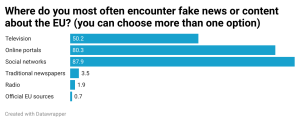
The same line is followed by the opinions of the surveyed citizens. About 88% of them encounter disinformation about the EU on Social Networks. While about 80% encounter it on online media and half of them encounter it on television. Media analyst, Çelik Rruplli, agree with this. He also states that: “Social Networks is often the source of the distribution of disinformation and also their amplifier at a second moment after they are commented on and re-distributed”.
Main narratives against the EU integration process
Disinformation, half-truths and content without context, whether coordinated or not, ultimately manage to build several narratives.
A total of 73 media articles published between 2019 and 2025 were analysed. Articles were selected from major online outlets (Top Channel, BalkanWeb, Syri.net, FaxNews, Tema.al, Euronews Albania, etc.) using keywords such as “EU integration”, “Europe”, “Anti-Europe”, “Russia”, and “China”. Each article was coded for tone (pro-EU, anti-EU, neutral), type (news, commentary, blog), and narrative category (e.g., “EU doesn’t want Albania”, “EU has double standards”, etc.). To verify the authenticity of the narratives, the analysis cross-referenced disputed content with EUvsDisinfo and other fact-checking databases such as Faktoje.al and Disinfo.al. By analysing those collected articles, we identified five narratives. Our analysis of the articles shows that about 40% were republished from Russian-affiliated domains.
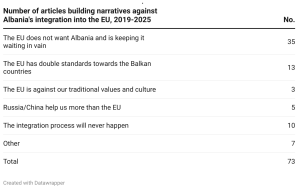
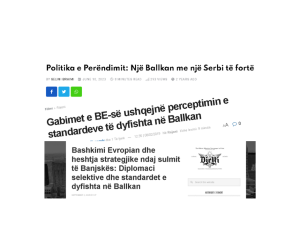
The headlines in the graphics below appear to build the narrative that the EU does not want Albania and is keeping it waiting in vain. The articles range from news from major media outlets to the opinions of political and geopolitical analysts, who emphasise that the European Union does not want love Albania and for this reason is dragging out the process, lying to it time to time, or that the EU itself is not keeping its commitments and promises to which it has pledged.
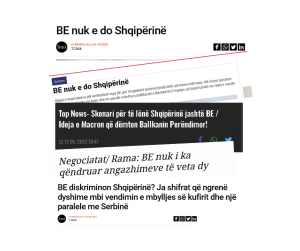
Although these narratives try to emphasise that the EU does not want Albania, the figures and facts speak differently. Initially, the start of negotiations eliminates any change. Then, various fact-checking, such as EUvsDiSiNFO articles refute the idea that the EU does not help Albania. “The EU is providing an EUR 3.3. billion package for the Western Balkans, including financial help to their healthcare sectors and exclusive access to EU instruments and medical equipment.”, claims the response article from EUvsDiSiNFO.
While the following articles illustrate how the narrative that the EU has double standards towards the Balkan countries is built. One of the articles throws the idea that the EU and the West (the USA) are working to create a strong state in the Balkans and this state is Serbia. Another article tries to present the mistakes that the EU has made in relation to the Balkans and how these mistakes have created the idea that the EU follows double standards in the Balkans. Although the article has this purpose, in the title acknowledges that this perception exists. Likewise, the third illustrative article insists on the idea that the EU has double standards in this region.
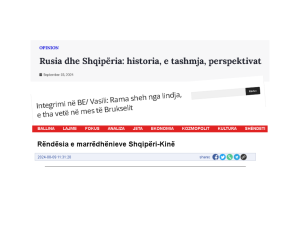
The illustrative headlines in this graphic below clearly show how the narrative that the EU is against our traditional values, beliefs and culture is built. According to all censuses after the fall of communism, Albania is a country with a Muslim majority. For many analysts, intellectuals, politicians and journalists, this is one of the main reasons why our country is not progressing with negotiations with the EU. The fact that Albania is a country with a Muslim majority, according to them, this is the reason why Albania will never be in the EU. The illustrative articles help consolidate this idea. The first headline shows that an Austrian newspaper writes that EU citizens do not want Albania because of their faith. The second article blames the people of this religion about the fact that Albania is not yet part of the EU. This idea is reinforced by an article that shows that the Prime Minister of Albania, Edi Rama, considers his country not a Muslim country, but a European one.
Regarding the narrative that Russia/China helps us more than the EU, the articles are of a political public relation nature. These articles are taken copy/paste from embassies or written by ambassadors. Up to this point, everything is normal. But online media take them and post them without any control over whether what is written in these articles is true or not, has context or not, is relevant to the public or not, complies with editorial policies or not. In addition to these articles, there are others that emphasise that, as a result of the stagnation of the EU integration process, the Albanian government may look east.
However, if we look at the EUvsDissinfo databases, there are disinformation stories that appear to build pro-Russian and anti-EU narratives, which prove that there have been attempts to interfere in the internal affairs countries in the Balkans. According to EUvsDiSiNFO, countries where interference was attempted include Balkan countries (Bosnia and Herzegovina, Montenegro, Albania ) and the East African island nation of Madagascar.
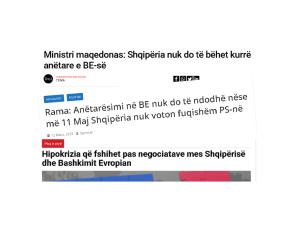
The integration process will never happen. This is what the following articles illustrate. This is emphasized by a minister of the Republic of North Macedonia. Also, another article shows that EU membership will never happen if Albanians do not vote for the government in power. Another article illustrates that behind the negotiation process lies the hypocrisy of the EU, implying that the process is false. But as is already known, the negotiations have been open since last year. And this narrative is considered false by EUvsDiSiNFO.
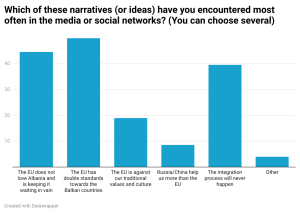
When asked which of these narratives they encountered most frequently, 381 citizens responded in a manner more or less similar to the results generated by the collection of articles. The only exception is the narrative related to the idea that Russia/China helps us more than the EU, a narrative that was rated as the rarest by citizens.
In Media analyst Çelik Rruplli’s view, the main narratives – supported by third countries in bad relations with the EU and NATO – are about portraying the EU as ‘expansionist’ to the detriment of Russia and other countries. These narratives, according to Rruplli, also consider the EU as a ‘destructive’ force of traditional values, especially when it comes to minorities such as refugees, the LGBT community, etc. “All media tools are used to disseminate these narratives to reach all the intended target groups,” he says.
For journalist Besar Likmeta, the transmission and then amplification of these narratives occurs for two main motivations. According to him: “The first is for economic reasons. These contents arouse reactions, receive likes, and encourage users to comment. While the second is for ideological reasons. In certain political situations, the opposition has its interests, e.g., to present the integration process negatively by blaming the government. Likewise, in other situations, the government has its interests in blaming the EU for stalling the process.”
Who produces the narratives against Albania’s integration into the EU?
“There are no structured and strategic disinformation campaigns in Albania,” says Besar Likmeta. According to him, most of them are news and misinformation content, which present half-truths or are news without context. “This news usually originates from Eurosceptics, mainly the extreme right or left in Europe. This news is translated into Albanian media and sometimes amplified by local actors, depending on the interests of the moment,” – he says.
According to Klajdi Kaziu, EU and integration expert, the actors, or rather the catalysts, are mainly local. First, there are uninformed journalists who do not even know the process itself and thus inform the public. Then there are politicians, who in principle have their own ideological positions. Whether they are left or right, in government or opposition, they try to avoid the facts and highlight only their ideas and discourse. “These include public figures who are often invited to television shows to comment on cultural or social issues, presenting conservative positions that resonate with certain segments of the public. Even though these positions are expressed as personal opinions, they can strengthen sceptical perceptions of EU values or policies,”, emphasises Klodiana Kapo. According to her, influencers, or people who manage pages with many followers, whether on Instagram or Facebook, also play an important role.
The respondents also think that these narratives come mainly from our own country. For the respondents, most of whom are created by the government, as a form of justification for the stalled negotiations, by blaming the EU. This intensifies during campaign periods. Another part also originates from the opposition, which tries to build its public discourse using all the resources it can.
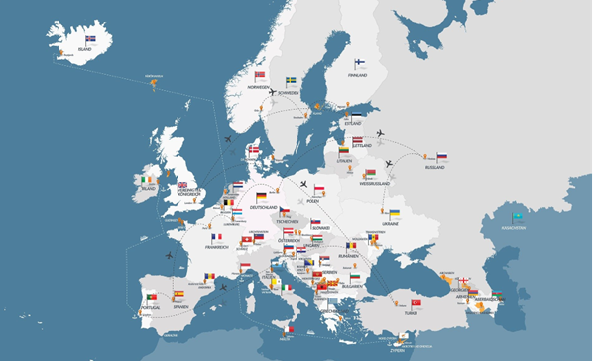
Part of the narratives, as shown in the map below, according to Likmeta, come from the EU itself, that is, its member states, where often the extreme left and right help generate and amplify anti-EU content, the echoes of which also reach Albania.
Also, a smaller part, the respondents think, comes from Russia, China and Arab countries. While another part, according to them, comes from the US, which, although seems justified, may stem from statements about US international policies.
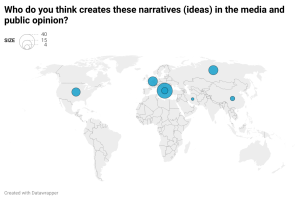
According to Likmeta, although in our country we do not have well-thought-out campaigns, some narratives against the EU are built or amplified by the media of countries such as Russia and China, which operate in Albania.
“Ideas can come from anywhere, from China, Russia or the USA, but this does not make you negative, nor does it bring any direct harm to the process.”- says Klajdi Kaziu. For him, what matters is the fact or argument they bring, the language they use and the deduction they make and that they ultimately throw into the public discourse. Especially when these facts, arguments or deductions are built from half-truths.
An important actor is the Albanian media. Besar Likmeta explains that “some other narratives are formed by our media, be they traditional or online media.” He shows that these media usually take the content and translate it from international media, which often have their sources from non-Western media. Especially news about the conflict in Ukraine and amplify it in our country, often without context.
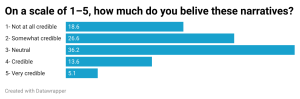
Although the data above shows that those who believe these narratives are a large majority are neutral.
For Rruplli, the impact of their narratives with the spread of disinformation is harmful to the model of governance of European countries based on democracy and the rule of law. Therefore, the weakening of institutions and the delegitimization of electoral processes are often the targets of such campaigns. While Likmeta clarifies that “However, the integration process itself is very complicated because it is closely linked to many factors such as: the development of Albania as a whole, its transformation, the improvement of services, free, free movement, and life in general.”.
Experts stand on the same line. Although those narratives demotivate the public, although they damage the image we have of the EU and its institutions, it is difficult to interfere in the Integration Process. “These developments not only damage the image of the EU, but also affect trust in local institutions and enthusiasm for reforms related to integration,”- says Klodiana Kapo.
Conclusions
What the data suggests is that disinformation about Albania’s EU integration does not function via one single orchestrated network but rather via an ecosystem of loosely connected actors-local media outlets, political figures, social media pages, and foreign sources, that constantly recycle and adapt the narratives to domestic contexts. While pro-Eastern and anti-EU messages spread widely, their capacity to reverse the public’s current pro-European orientation seems limited. These narratives function rather as background noise, normalizing skepticism and distrust toward local and European institutions.
It is not a sudden shift in public opinion that is the real risk, but rather the slow erosion of critical trust, a situation in which citizens remain nominally pro-EU yet indifferent to the democratic values that integration implies. In this sense, Albania’s vulnerability to disinformation is less a matter of exposure to foreign propaganda and more about weaknesses in its own media culture and political communication. This finding reframes the question: the problem is not how much disinformation Albania receives, but how little verified, contextual, and meaningful information it produces.
The EU Integration Process is bureaucratic and requires the fulfilment of many conditions, which makes communication with the Albanian public very complex. This communication becomes even more necessary when disinformation, half-truths and propaganda content circulate in the media landscape. To improve this situation, according to experts, proactive communication with citizens regarding the decisions taken is needed, increasing institutional transparency, protecting European values and debunking/rejecting toxic narratives.











Lini Komentin tuaj
Adresa juaj e emailit nuk do të publikohet. Fushat e kërkuara janë shënuar me *